

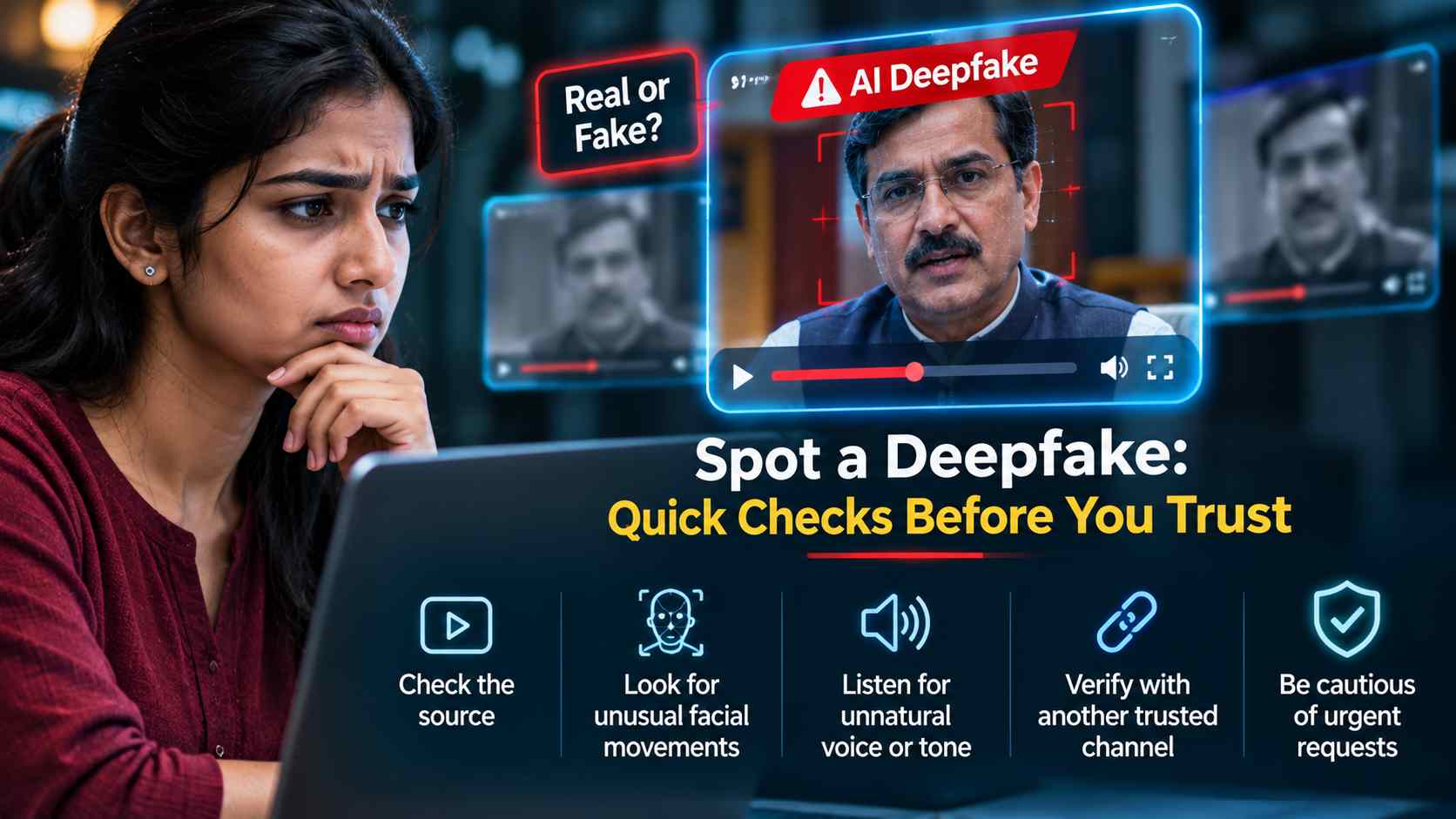

Imagine receiving a phone call from a family member asking for urgent financial help. The voice sounds familiar. The emotion feels real. But what if the person speaking isn't actually your family member?
Artificial intelligence can now generate convincing voices, faces and videos. While these technologies have creative and useful applications, they can also be misused to deceive people.
Welcome to the age of AI deepfakes, where seeing and hearing something is no longer enough to prove it's real.
What Exactly Is an AI Deepfake?
A deepfake is an image, video or audio recording created or manipulated using artificial intelligence to make someone appear to say or do something they never actually said or did.
For example, AI can imitate a person's voice, alter facial movements in a video or create realistic-looking footage of an event that never happened.
Not all synthetic media is harmful. AI-generated visuals can be used in entertainment, education and creative production. The problem begins when manipulated content is presented as genuine to mislead, impersonate or exploit someone.
How Common Are Deepfakes in India?
McAfee's February 2026 State of the Scamiverse report revealed some striking findings about the experiences of Indian survey respondents.
- 4 deepfakes per day: The average number respondents reported encountering.
- 1 in 5: The approximate share who said they had encountered a voice-cloning scam.
- More than 1 in 3: The share who were not confident they could identify a deepfake scam.
These are self-reported survey findings, not verified counts of every deepfake encountered in India. Still, they highlight a growing challenge: people are increasingly uncertain about what they can trust online.
Explore McAfee's 2026 State of the Scamiverse research.
Three Ways Deepfakes Can Mislead People
| Type | How It Can Be Misused |
|---|---|
| Voice Cloning | Imitating a family member, colleague or official to request money or confidential information. |
| Fake Videos | Making a public figure appear to endorse a product, investment scheme or misleading claim. |
| Manipulated Images | Creating misleading photographs, fake identities or fabricated evidence. |
The common problem is impersonation: making something artificial appear trustworthy because it resembles a familiar person or situation.
Why Spotting a Deepfake Is Getting Harder
Older manipulated videos sometimes had obvious problems, such as unnatural blinking, strange facial movements or poorly synchronized audio.
Those clues can still be useful, but modern AI-generated content may look and sound much more convincing.
Even automated detection tools have limitations. The US Federal Trade Commission has highlighted the challenges of detecting voice cloning and the importance of authentication and other protective measures.
Read the FTC's guidance on AI-enabled voice cloning.
India Is Taking Action Against AI Deepfakes
In February 2026, the Indian government amended its Information Technology Rules to strengthen safeguards relating to synthetically generated content, including deepfakes.
The amendments introduced requirements concerning the identification and labelling of certain AI-generated content, platform responsibilities and faster action against unlawful material.
A July 2026 government update also reported that 13 responsible AI projects had been approved for deepfake detection.
These developments show that deepfakes are no longer simply a technology curiosity. They have become an issue involving online safety, platform accountability and public trust.
Read the Government of India's July 2026 update on deepfake safeguards.
How Can You Protect Yourself?
You don't need advanced technical knowledge to reduce your risk. A few everyday habits can make a meaningful difference.
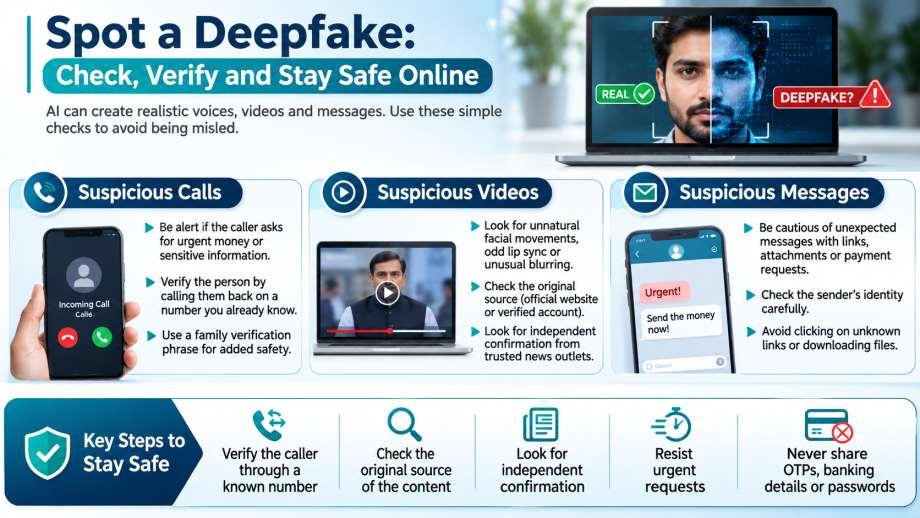
- Verify unexpected calls: If someone urgently requests money, contact them using a number you already know.
- Don't trust a video just because it looks real: Check its original source and look for independent confirmation.
- Be cautious about urgency: Fraudsters often pressure people to act before they have time to think.
- Protect personal information: Avoid sharing passwords, OTPs, banking details or sensitive documents with unverified contacts.
- Consider a family verification phrase: A privately agreed phrase can provide an additional identity check during suspicious calls.
If you suspect a financial cybercrime in India, you can report it through the National Cyber Crime Reporting Portal or contact the cybercrime helpline at 1930.
The Future of AI: Can We Rebuild Digital Trust?
AI-generated media will continue to improve, and its legitimate uses will expand alongside the risks.
Technology companies, governments and online platforms are exploring labels, content provenance, detection tools and stronger identity-verification methods.
But one lesson is already clear: the safest approach is not to assume everything online is fake or real. It's to verify important claims before acting on them.
Interested in building safer and smarter digital experiences? Connect with Accolade Tech Solutions to explore AI application development, secure software solutions and customized technology requirements.
Contact: 9900448554 | Website: accoladetechsolutions.com